




























How to Read anEyeglasses Prescription?
Everything you need to know about the terms on your eye prescription.
Staring at a prescription full of numbers and abbreviations can feel like reading a different language. Between SPH, CYL, axis, and PD, it's easy to get lost before you've even started shopping for frames. This guide breaks each term down in plain English, so you can order your next pair of glasses with total confidence.
Already have your numbers in hand? Great, keep them nearby as you read. If you don't, a quick visit to your eye doctor will get you a full, up-to-date prescription.
How to Read an Optical Prescription
Here is a video to help you understand your prescription with the relevant visuals. We have simplified every term so the numbers on your prescription are easier to follow.
Sphere (SPH)
SPH tells you the strength of lens power you need, and the sign in front of it tells you which way your vision is off. A minus sign (–) means you're nearsighted, so distant objects look blurry while close-up ones stay sharp. A plus sign (+) means you're farsighted, so it's close-up vision that gives you trouble.
Eyeglasses Prescription
John Dew
MM/DD/YYYY
R
L
SPH
+1.75
+1.00
CYL
-
-
AXIS
-
-
PRISM
-
-
ADD
-
-
Pupil Distance:
Cylinder (CYL)
CYL measures astigmatism, a common and totally normal irregularity in the curve of your eye. Picture your eye as a basketball, which is round in every direction. Now picture a football, slightly oval from end to end. Astigmatism means your cornea is shaped more like the football, and the cylinder number measures how much.
The higher the cylinder number, the more oval-shaped your eye is, and the more it affects your vision. A "0" or a blank CYL field simply means your eye is close to a perfect sphere. It means you don’t need correction for astigmatism.
Eyeglasses Prescription
John Dew
MM/DD/YYYY
R
L
SPH
-
-
CYL
-0.25
+0.75
AXIS
-
-
PRISM
-
-
ADD
-
-
Pupil Distance:
Axis
Axis works together with cylinder to pinpoint exactly where the astigmatism sits on your eye. It's expressed in degrees, from 0 to 180, and tells your lens maker precisely which direction to angle the correction so it lines up with the irregularity in your cornea.
Eyeglasses Prescription
John Dew
MM/DD/YYYY
R
L
SPH
-
-
CYL
-
-
AXIS
80°
110°
PRISM
-
-
ADD
-
-
Pupil Distance:
Prism
Prism corrects eye alignment problems which can cause double vision when your eyes don't quite point in the same direction. You'll usually see a number (the strength of the correction) paired with a direction: BU (base up), BD (base down), BI (base in), or BO (base out). Together, they tell your optical technician how to redirect light so your eyes work as a team again.
Eyeglasses Prescription
John Dew
MM/DD/YYYY
R
L
SPH
-
-
CYL
-
-
AXIS
-
-
PRISM
1 Out
1 Out
ADD
-
-
Pupil Distance:
Add
ADD is extra magnifying power added to the bottom of your lens, most often prescribed for presbyopia. Presbyopia is a natural, age-related loss of close-up focus that tends to show up in your 40s. It's always a positive number, and it tells your optical technician how much extra strength you need for reading and other close-up tasks.
Eyeglasses Prescription
John Dew
MM/DD/YYYY
R
L
SPH
-
-
CYL
-
-
AXIS
-
-
PRISM
-
-
ADD
+2.00
+2.00
Pupil Distance:
Pupillary Distance (PD)
Your pupillary distance, or PD, is the distance between the centers of your two pupils, measured in millimeters. It's what lets your lens maker center the optical sweet spot of each lens directly in front of your eye. Most eye doctors measure PD as part of a routine exam, but you can also measure it yourself at home if it isn't listed on your prescription.
Eyeglasses Prescription
John Dew
MM/DD/YYYY
R
L
SPH
-
-
CYL
-
-
AXIS
-
-
PRISM
-
-
ADD
-
-
Pupil Distance: 63
Distance between your pupils
Understanding the Eye Prescription Scale
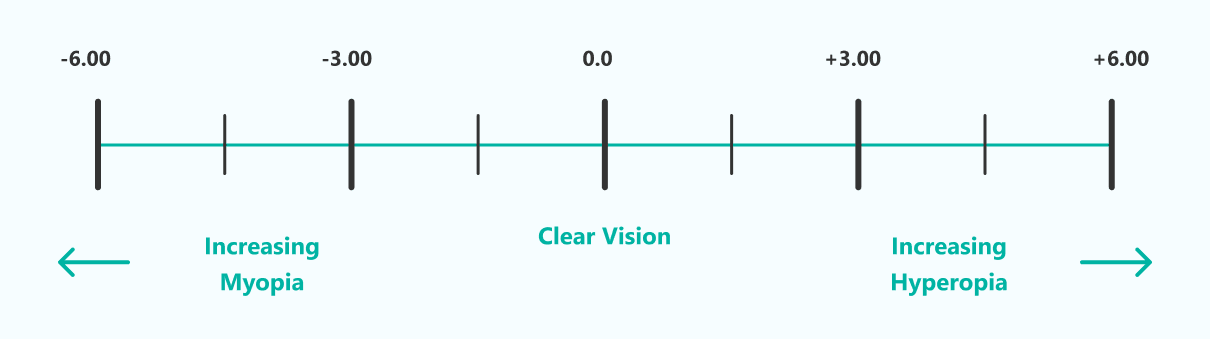
The numbers on your prescription represent diopters, which is the unit that measures how much correction your lens needs. They can run positive or negative, and the further from zero, the stronger the correction.
Negative numbers (–): Nearsightedness (Myopia) A minus sign means you're nearsighted. It means things up close are clear, but distant objects blur. The bigger the negative number, the stronger your prescription. For example, –3.00 is a stronger prescription than –1.00.
Positive numbers (+): Farsightedness (Hyperopia) A plus sign means you're farsighted. It means distance vision tends to be clearer, while close-up objects take more effort to focus on. The bigger the positive number, the stronger the correction. For example, +4.00 is a stronger prescription than +1.00.
Zero (0.00): No Correction Needed A prescription of 0.00 means your eyes don't need any correction for that particular measurement.
Still Unsure About Your Prescription?
No worries, we're here to help. Send us your prescription at support@specscart.com, and our team will walk you through it, from decoding the numbers to picking the right pair of glasses for you.
FAQs
What is CYL in an eye prescription?
CYL, or cylinder, measures astigmatism, which is an irregularity in the curve of your eye that affects how light focuses on your retina.
What is SPH in an eye prescription?
SPH is the lens power needed to correct your vision. A negative number means you're nearsighted, while a positive number means you're farsighted.
What is the legal blindness prescription?
In the US, legal blindness is defined as visual acuity of 20/200 or worse in your better eye with the best possible correction, or a visual field of 20 degrees or less in diameter. It isn't based on a single glasses prescription number, but on how well you can see even while wearing corrective lenses. This definition is used by the Social Security Administration and other federal agencies to determine eligibility for disability benefits and other assistance programs.
What is a normal eye axis?
Axis refers to where astigmatism sits on your cornea, measured in degrees from 0 to 180. A "normal" axis reading usually means there's little to no astigmatism, typically below 0.50 diopters. Astigmatism above 1.50 diopters usually needs correction, while a reading of zero means there's no astigmatism at all.
What do OD and OS mean on a prescription?
OD stands for "oculus dexter," Latin for right eye. OS stands for "oculus sinister," Latin for left eye. You'll often see these instead of "R" and "L" on prescriptions written by US eye doctors, with the correction for each eye listed right next to it.
What does BVD mean on a prescription?
BVD stands for "back vertex distance," which is the space between the back surface of your lens and the front of your eye (the cornea). It typically only appears on stronger prescriptions, since that distance affects how accurate a high-powered lens is.


